




The Ministry of Climate Change and Environment unveiled the National Measurement, Reporting and Verification system during an event at GITEX Global 2025 in Dubai, the Emirates News Agency reported. This platform integrates monitoring of greenhouse gas emissions with air pollutant data, creating the first such unified national tool in the region. Dr. Amna bint Abdullah Al Dahak, the minister, emphasised its importance in providing reliable information for decisions that advance the UAE Net Zero 2050 Strategy and the National Air Quality Agenda 2031.
The system streamlines previously manual processes into automated workflows that cut inventory preparation time from 15 months to three months while reducing reporting steps by 64 percent, according to a ministry presentation at the launch. It enables collaboration among national and local entities through a single user-friendly interface that replaces complex spreadsheets with targeted data fields. Private companies can register, identify their sectors and receive automatic forms tailored to their activities.
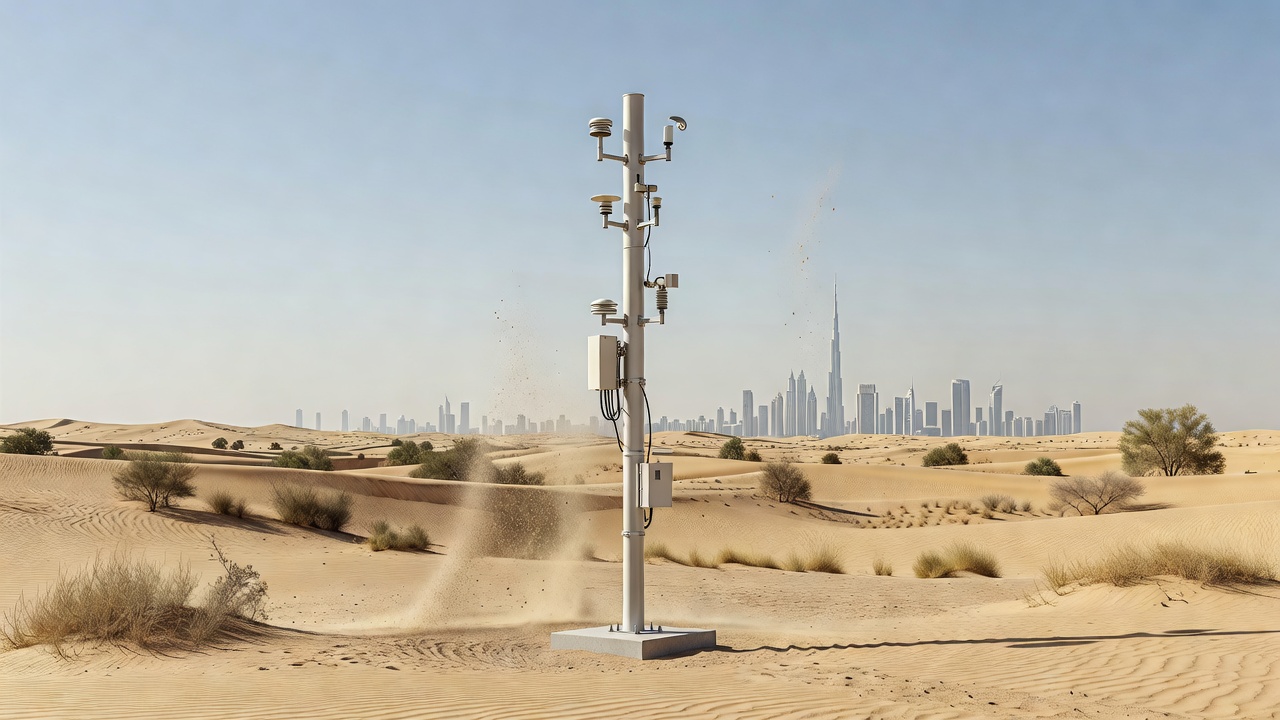
A national network of 56 air quality monitoring stations supplies core data to the platform, with 20 located in Abu Dhabi, 14 in Dubai and the remainder distributed across other emirates, official tallies show. These stations measure key pollutants such as nitrogen dioxide, carbon monoxide, ozone, sulphur dioxide and particulate matter. The Environment Agency Abu Dhabi has additionally linked 75 industrial smokestacks to real-time emissions sensors that update every 30 minutes.
Figures from the 2025 World Air Quality Report by IQAir placed the UAE’s annual average PM2.5 concentration at 36.4 micrograms per cubic metre, the third highest in West Asia. Natural dust events, construction activity, industry and transport contribute to these readings across the region. The integrated platform is designed to identify pollution sources more precisely so authorities can deploy targeted interventions.
An artificial intelligence laboratory operated by the ministry in partnership with Khalifa University and the International Renewable Energy Agency generates forecasts for six air quality parameters up to three days ahead, a ministry statement said. Public access to this information occurs through a dedicated mobile application that displays real-time indices and associated health recommendations. Separate modelling work by the Environment Agency Abu Dhabi uses mathematical techniques to predict sandstorms with near complete accuracy.
Dr. Amna bint Abdullah Al Dahak stated, “We cannot manage what we cannot measure. The launch of the National MRV system represents a quantum leap in our environmental governance.” The minister added that the tool strengthens compliance with international transparency requirements under the Paris Agreement. Development occurred through three pilot phases that tested the system with stakeholders before full deployment.