


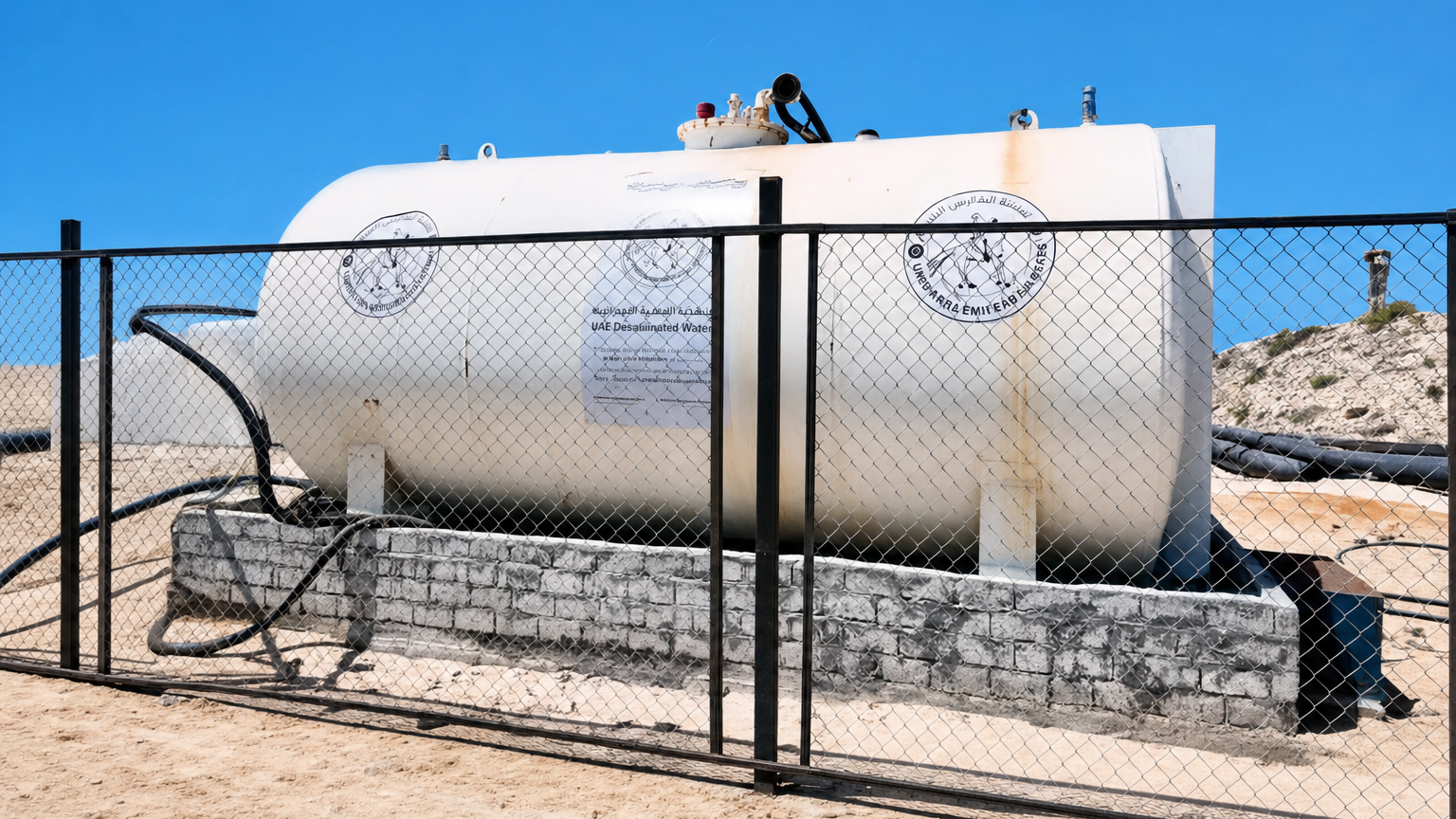

The Emirates News Agency reported that Operation Chivalrous Knight 3 has connected the new pipeline from Emirati desalination facilities in Rafah, Egypt, to the Al-Buraq reservoir in Khan Younis, enabling distribution to the Al-Mawasi area and other displacement sites in southern Gaza. This infrastructure forms a core element of the operation’s response to the water crisis, with capacity to supply up to 15 litres of potable water daily to approximately 600,000 people. The initiative extends prior work that established six desalination plants now producing roughly two million gallons per day while incorporating well drilling and network upkeep across the territory.
United Nations Office for the Coordination of Humanitarian Affairs assessments indicate more than 80 percent of Gaza’s water facilities have been damaged or destroyed, forcing 74 percent of residents to depend on trucked supplies amid equipment shortages that have slashed southern desalination output. The International Committee of the Red Cross has documented overall water production falling to about 40 percent of pre-conflict volumes, with per capita availability for drinking, cooking and hygiene often below the seven-and-a-half-litre survival threshold during summer peaks. These conditions have compounded health risks for displaced families living in tents, many of whom face repeated outages and rely on informal sources of uncertain quality.
Operation Chivalrous Knight 3 launched the fourth phase of its central well maintenance project in May 2025, targeting facilities in multiple municipalities to restore groundwater access and sustain local extraction systems. The program has included provision of water tankers, storage reservoirs and repairs to distribution networks, according to updates from the Emirates News Agency. Such steps have allowed the operation to maintain continuous support even as cross-border coordination with Egyptian partners ensures quality testing and steady flow from the seawater treatment units.
Sharif Al Nairab, media official for the operation, said in a statement that the pipeline is not merely an emergency response but an extension of the UAE’s consistent approach to aiding Palestinians under catastrophic conditions caused by the war. He noted that the UAE has remained the primary supporter across sectors ranging from desalination construction to tanker deliveries, well drilling and network maintenance. The official added that these combined measures seek to secure safe drinking water specifically for the hardest-hit zones and vulnerable populations.
The Coastal Municipalities Water Utility has partnered with Emirati engineering teams to oversee implementation, including real-time monitoring of output that has at times reached 10,000 cubic metres daily through the expanded pipeline system. This collaboration has prioritised delivery to collective shelters and areas with high concentrations of displaced residents, where local wells remain either inaccessible or insufficient. Additional reservoirs linked to the Al-Buraq facility, which holds 5,000 cubic metres, help buffer supply against fluctuations in demand or operational constraints.
Broader UAE humanitarian contributions through the operation have totalled billions in aid since 2023, representing a significant share of international assistance reaching Gaza according to compiled reports. The water-specific projects align with parallel efforts in health and shelter, creating an integrated framework that addresses immediate needs while seeking to rebuild limited infrastructure resilience. Ongoing challenges around spare parts and fuel for generators continue to test these systems, yet the pipeline has provided a stable supplement where traditional sources have failed.