



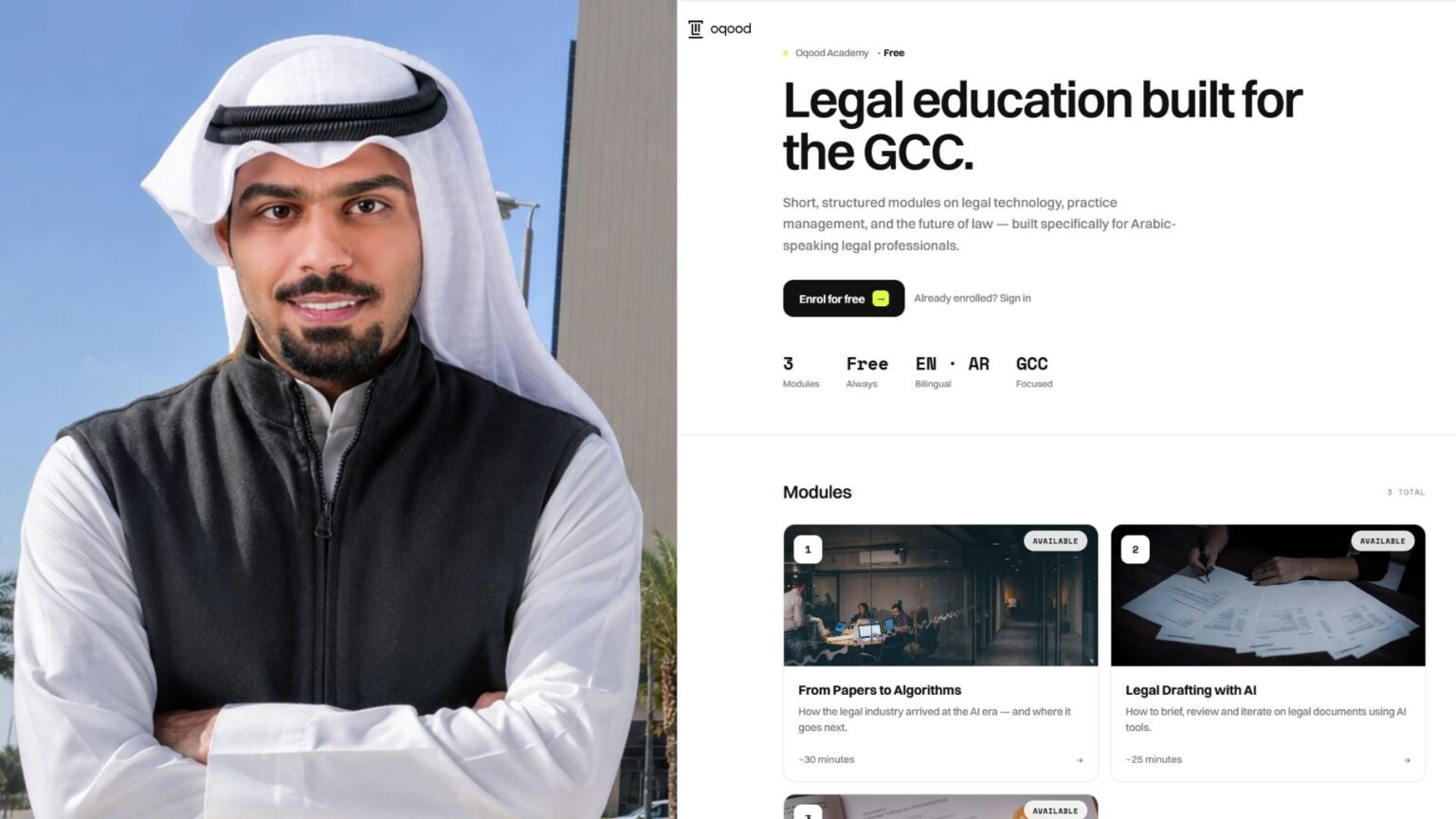

Adoption of legal AI has doubled in a year, but more than half of firms provide no training to match it. Oqood Contracts Academy makes the skills to close that gap free to every lawyer and law student in the region.
Oqood AI, the Gulf’s first Arabic AI-powered legal platform, has launched Oqood Contracts Academy, which it describes as the region’s first interactive, fully free legal learning platform. The premise is deliberately simple: modern legal knowledge should be accessible to every legal professional and student in the region, without cost and without barriers.
The timing speaks to a real and widening gap. Adoption of AI among legal professionals has moved from the margins to the mainstream at remarkable speed, with nearly 70% now using generative AI tools for work in 2026, more than double the 31% recorded a year earlier, according to the 8am 2026 Legal Industry Report. But the institutions those lawyers work for have not kept pace. The same research found more than half of firms, 54%, provide no training on the responsible use of AI and have no plans to do so. Individual enthusiasm has raced ahead of the structures meant to support it, leaving lawyers to navigate powerful new tools largely on their own.
That is the gap Oqood Contracts Academy is built to close.
Education aimed at a profession in transition
The academy delivers short, structured interactive modules on legal technology, legal practice, and the future of the profession, built specifically for Arabic-speaking legal professionals. Its content is renewed weekly, tracking a field changing faster than traditional legal education can follow, and it is offered on a principle the platform states plainly: legal knowledge is a right, not a privilege, with no subscriptions for anyone.
What distinguishes it is who it is built for. Rather than general legal theory, its modules focus on the intersection where the profession is actually being reshaped, addressing three audiences at once: the lawyer who wants to keep pace with the future, the law student beginning their journey, and the legal team aiming to develop. One module is themed around the shift “from paper to algorithms,” tracing how the legal sector reached the age of artificial intelligence and where it goes next. Another addresses AI-assisted legal drafting, how to guide, review, and develop legal documents using AI without losing the professional judgment that defines a lawyer.
These are not abstract topics. They map directly onto what the profession itself now values. A Wolters Kluwer 2026 Future Ready Lawyer survey found 39% of legal professionals identify inadequate training as a persistent barrier to AI success, and separate research found 61% of legal professionals believe technical fluency with AI tools will become more valuable as adoption increases. The skills the academy teaches are precisely the ones lawyers expect to need.
Why a legal-AI company is building a school
On its face, a legal-technology company investing in free education is an unusual move. But it follows a clear logic. The barriers slowing AI adoption in law are as much about understanding as about the technology itself: alongside data-security and ethics concerns, a lack of AI knowledge and inadequate training rank consistently among the obstacles firms cite, and with only a small fraction of firms offering structured training, the shortfall is largely unaddressed.
By making education free and continuously updated, Oqood addresses that gap at its root. A profession that understands how legal AI works, where it helps, and where human judgment remains essential is one better equipped to adopt it well. For a company whose platform is built around exactly that balance, an intelligent legal workspace designed to augment lawyers rather than replace their judgment, raising the region’s collective fluency in legal technology is aligned with the business, not a distraction from it.
Part of a broader platform
The academy sits alongside Oqood’s core product, an enterprise-grade legal workspace built for the MENA region spanning a legal assistant, a legal library, document review, and drafting workflows, all designed to operate across Arabic and English and within the civil-code systems that govern Gulf legal practice. The academy extends that mission from the product into the profession: where the platform helps lawyers work, the academy helps them learn.
It also reflects a conviction that has run through Oqood’s approach from the start, that the future of legal work in the region will be built with the profession rather than sold to it. Free, open education is a direct expression of that idea, widening access to the skills the next phase of legal practice will demand, for the students and practitioners who will define it.
An open invitation
The academy is available now, free to anyone who wants to use it, with new content added each week. For a generation of lawyers and law students entering a profession being reshaped by artificial intelligence, it offers something that has traditionally been expensive and hard to reach: current, practical, accessible legal-technology education, built in their language, for their market, and open to all.