



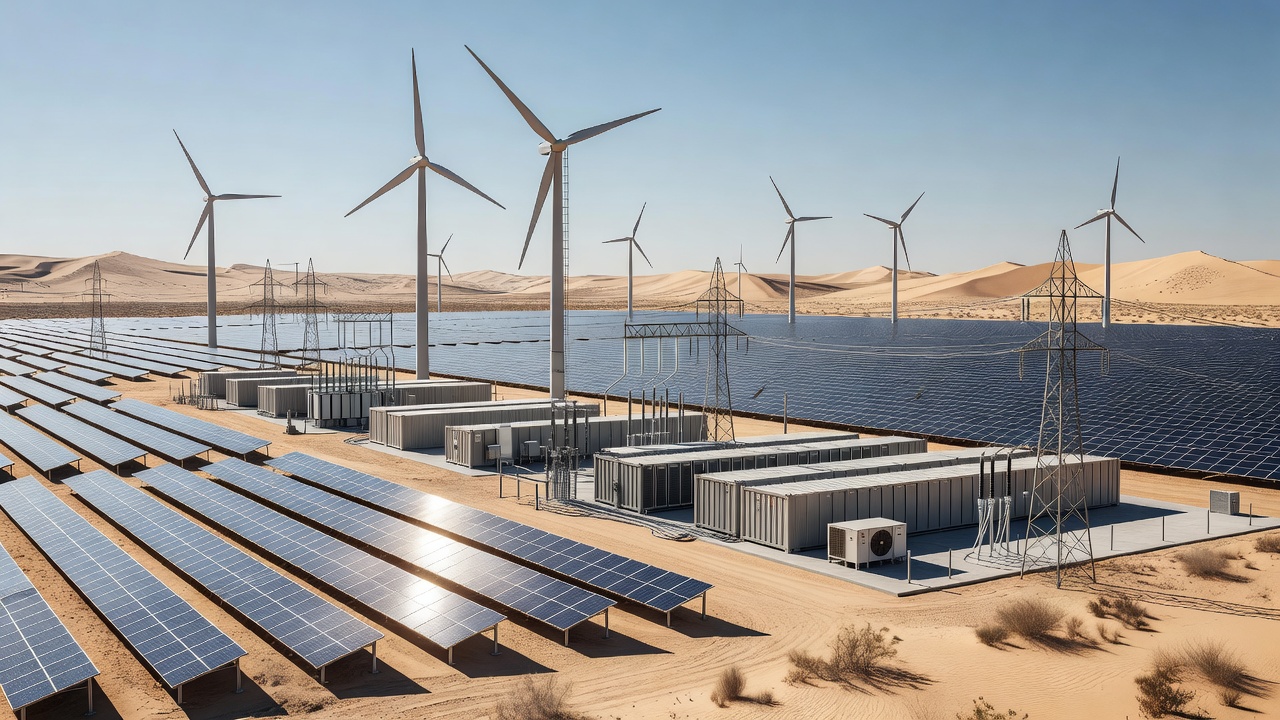

Masdar has closed financing on the $6.1 billion project that combines multiple renewable technologies to provide continuous clean power supply, according to a statement issued by the company. The development stands as the first gigascale effort of its kind worldwide and forms part of broader efforts to advance decarbonisation across industrial and grid applications. Project details released by Masdar indicate the scheme will operate at utility scale while maintaining output around the clock through integrated generation and storage systems.
The company statement identified the initiative as a landmark in renewable energy deployment that pairs solar photovoltaic arrays with wind turbines and large-scale battery storage. Such a configuration allows the facility to dispatch electricity irrespective of weather or time of day, Masdar reported. International Renewable Energy Agency assessments have highlighted similar hybrid approaches as critical for increasing the share of variable renewables in power systems globally.
Masdar’s release placed the total investment at $6.1 billion and noted the project will be located in a strategic site selected for its renewable resource potential and grid connectivity. The financial close brings together a syndicate of international lenders and equity partners, the company said. Earlier company disclosures show Masdar has developed more than 20 gigawatts of clean power capacity across more than 40 countries as of mid-2025.
According to Masdar, the 24/7 capability addresses a key limitation of standalone solar and wind installations by incorporating storage solutions capable of shifting output to peak demand periods. The project aligns with the United Arab Emirates’ national energy strategy that targets net-zero emissions by 2050, a goal reiterated in successive government policy documents. BloombergNEF data published last year indicated that global investment in battery storage paired with renewables exceeded $40 billion in 2025 alone as developers pursued firmer power contracts.
The statement from Masdar outlined that construction is expected to commence within months and reach commercial operations by the end of the decade. Once operational the facility will displace significant volumes of fossil-fuel generation each year, the company projected. Industry analysts tracking Middle East renewable pipelines have noted that projects of this scale are increasingly attracting concessional finance from development banks eager to accelerate the energy transition.
Masdar added that the financial close validates growing investor confidence in hybrid renewable models capable of providing baseload-equivalent clean power. The announcement coincides with rising corporate demand for around-the-clock renewable electricity to meet internal decarbonisation commitments. Separate figures compiled by the International Energy Agency show that annual additions of solar and wind capacity must triple by 2030 if global climate targets are to remain attainable.