

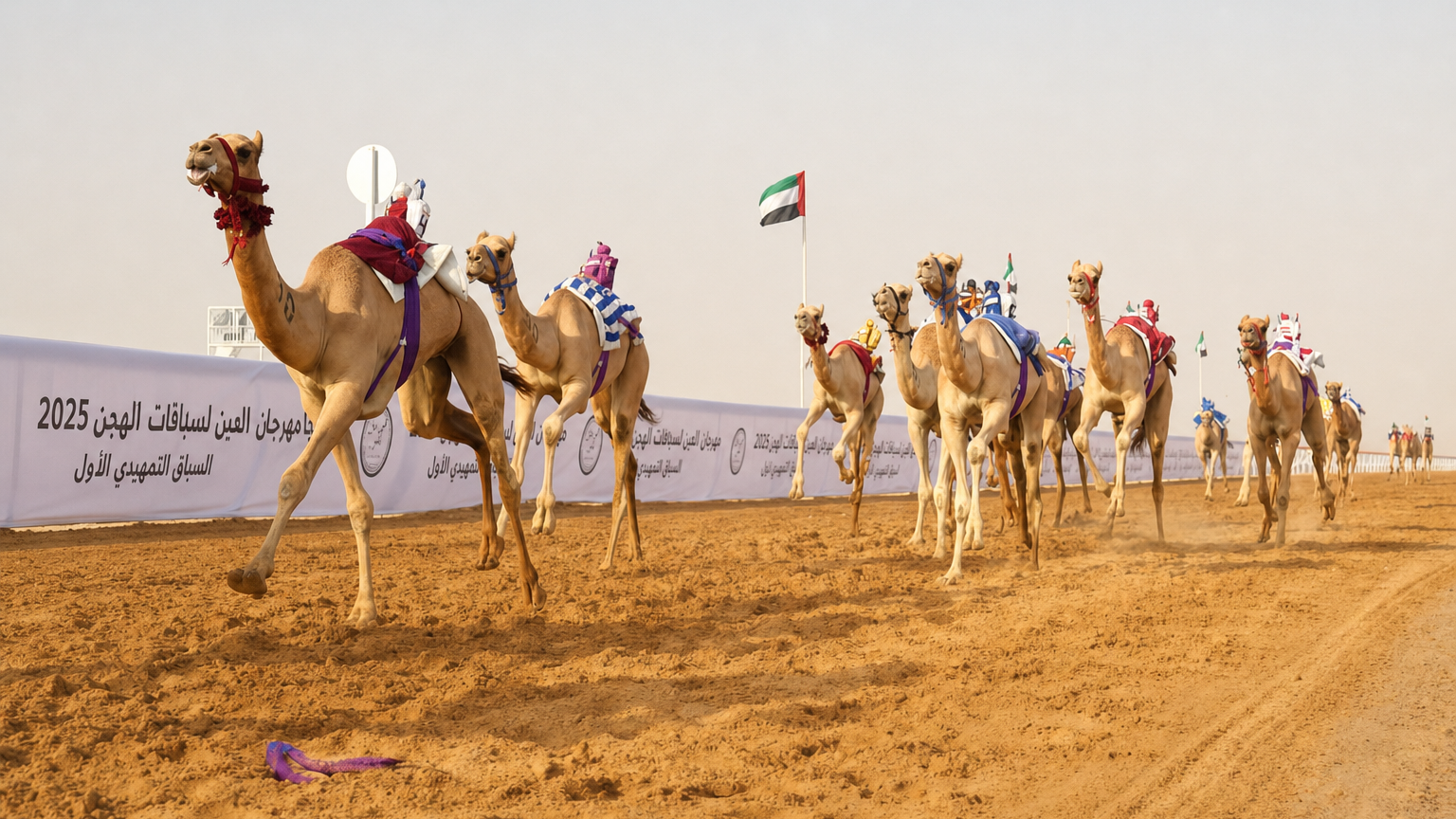

The Presidential Camels and Camel Racing Affairs Centre has scheduled the concluding phase of the 2nd Al Ain Camel Racing Festival to open on October 3 under the directives of President His Highness Sheikh Mohamed bin Zayed Al Nahyan and with the patronage of H.H. Sheikh Hazza bin Zayed Al Nahyan, Ruler’s Representative in Al Ain Region. According to the Emirates News Agency, the centre is organising the event in coordination with the Camel Racing Association, which is supervising all activities at the Al Rawda Camel Racetrack. The finals will honour standout performers from the earlier rounds held during July, August and September while advancing the sport’s role in preserving national traditions.
Organisers outlined a programme of 605 races spread across the full festival, the Emirates News Agency reported, with contests divided among the Fattameen, Haqayeq, Laqaya, Itha’a, Thanaya, Houl and Zomool age groups. All heats take place in the morning over distances adjusted to suit each category’s competitive standards, the centre said. This format highlights the technical development within UAE camel racing and maintains consistent rules for participants from across the country and the GCC.
The inaugural edition of the Al Ain Camel Racing Festival in 2025 succeeded in attracting broad local and regional involvement while upholding strong organisational levels, according to the Camel Racing Federation. That first running elevated the visibility of camel racing as a cornerstone of Emirati cultural and sporting life. It further promoted wider engagement by younger owners, reinforcing the sector’s long-term sustainability.
Sheikh Sultan bin Hamdan Al Nahyan, who serves as Advisor to the UAE President and Chairman of the Camel Racing Federation, described the festival as a strategic milestone for the sport’s growth. In statements carried by the Emirates News Agency, Al Nahyan emphasised its contribution to increasing participation among camel owners, particularly young people. He added that such events help guarantee the continuity of Emirati heritage by transmitting its practices to coming generations.
Camel racing traces its modern expansion in the UAE to the 1970s when the late Sheikh Zayed bin Sultan Al Nahyan supported the construction of specialised tracks across multiple emirates, a historical overview published by The National newspaper in 2011 noted. What began as an informal Bedouin activity evolved into an organised industry with dedicated facilities and growing prize funds. The sport now forms part of a broader heritage revival that blends cultural preservation with structured competition.
Comparable events such as the Al Marmoom Heritage Festival have distributed prize pools reaching AED 8.95 million on final days alone, a summary by the Dubai Camel Racing Club indicated. The Al Ain festival follows a similar approach by offering valuable awards to top finishers throughout its schedule. Regional benchmarks show that successful camels can see their market value rise by as much as 300 percent after strong performances, according to a sector review published on ohepic.com.