



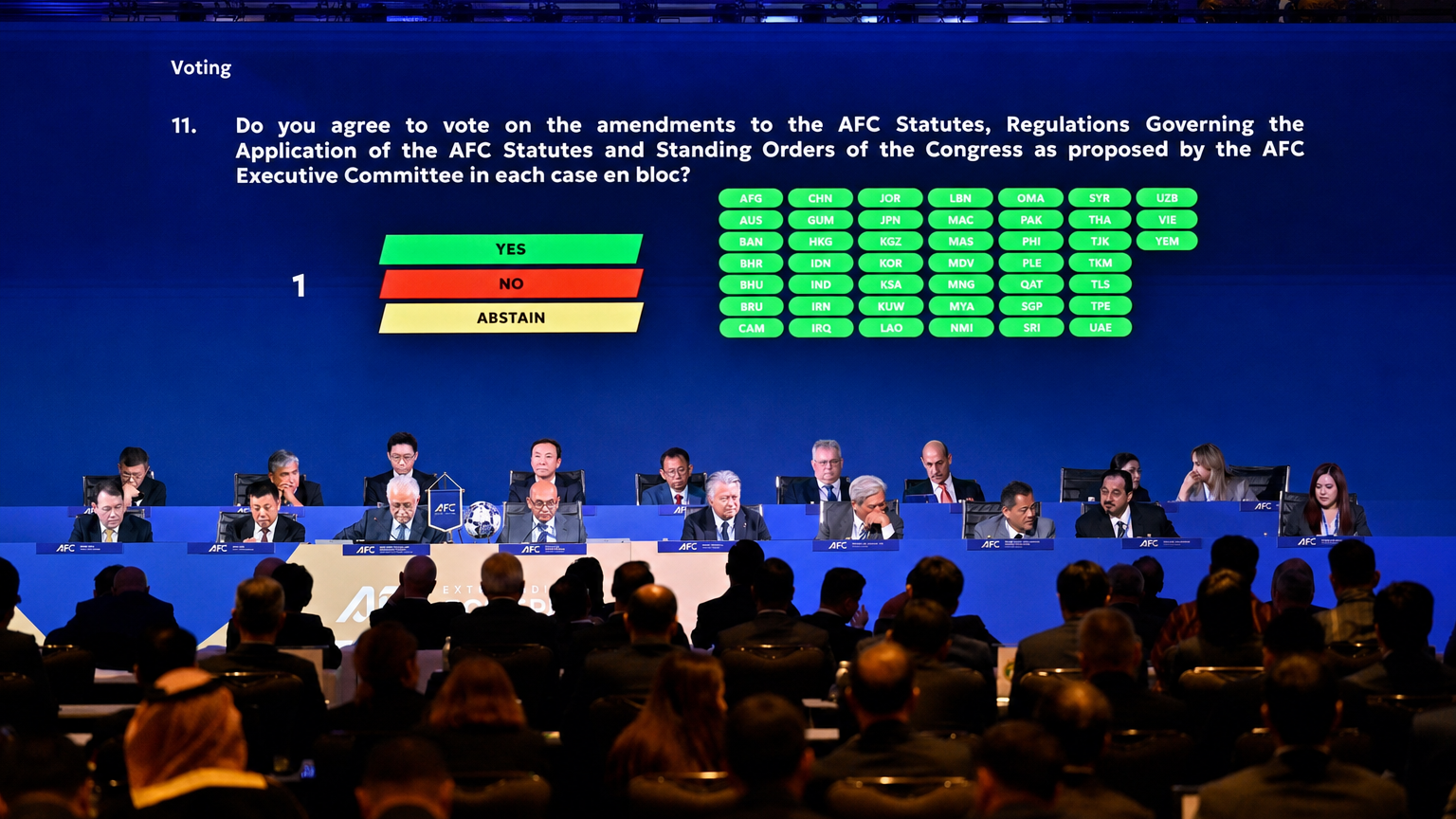

The Asian Football Confederation convened its Extraordinary Congress in Tokyo where delegates approved a series of statutory amendments aimed at enhancing governance structures. According to the AFC, these changes were crafted in close consultation with FIFA to address exceptional circumstances linked to revisions in the global competitions calendar. The congress focused on ensuring seamless alignment between the confederation’s electoral processes and its flagship tournaments while maintaining operational stability across all activities.
AFC General Secretary Datuk Seri Windsor John outlined the proposals during the proceedings, which secured unanimous backing from all participating member associations. The approved amendments introduce transitional governance rules that allow the current executive committee to continue in office throughout 2027. Those elected during the 2027 Ordinary Congress will assume their roles on January 1, 2028, for a term running through 2032, the AFC stated in its official release.
The reforms mandate that the AFC Asian Cup shift to even-numbered years starting with the 2032 edition, synchronizing the tournament with the election cycle. This adjustment enables the executive committee to supervise essential organizational stages without interruption, the confederation explained. Regional associations must now update their own statutes and election schedules to match the new framework, as directed by the congress outcomes.
The gathering in Japan followed the AFC Member Associations and Regional Associations Presidents’ and General Secretaries’ Conference held in the preceding days, which centered on leadership development and innovative strategies for the sport. AFC President Shaikh Salman bin Ebrahim Al Khalifa addressed the delegates, stressing the need for these updates to reinforce unity and long-term planning. The Extraordinary Congress built upon decisions from the 36th AFC Congress staged in Vancouver in April 2026, according to the confederation’s published agenda.
These modifications form part of the AFC’s broader initiative to strengthen transparency and administrative efficiency while overseeing football across 47 member associations. An AFC assessment found that calendar alignment prevents disruptions to development programs and competition management throughout the continent. The changes also set an age limit for candidates, requiring them to be under 70 years old as of January 1, 2028, under the revised eligibility criteria.